
META ADS VS GOOGLE ADS: UNDERSTANDING THE DIFFERENCE
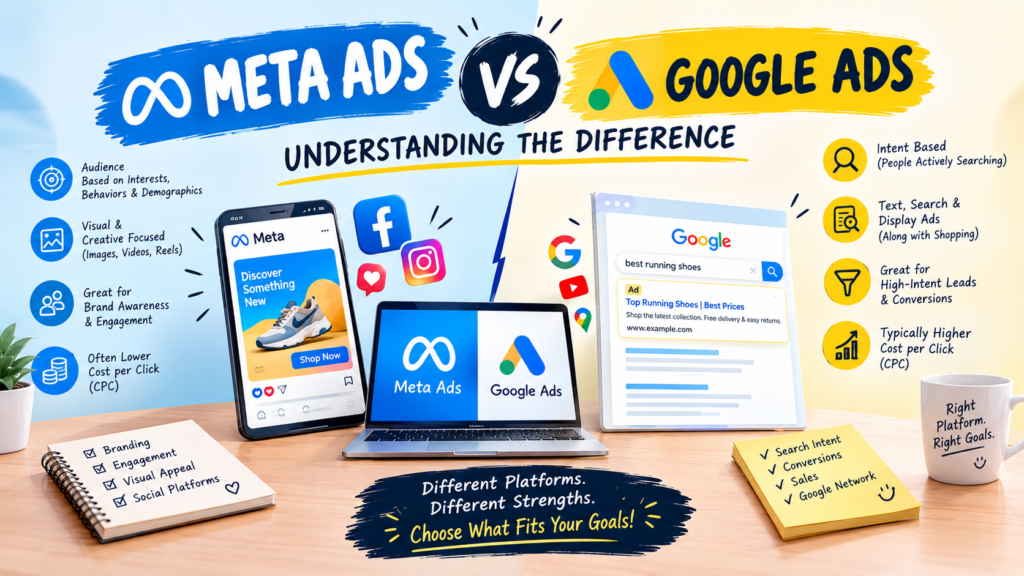
Where should your business spend its advertising budget—Meta Ads or Google Ads? 🤔
If you’re looking to reach more customers online, both platforms can be powerful tools. But they work in very different ways.
Meta Ads help businesses reach people based on their interests, behaviors, and demographics, while Google Ads primarily connect businesses with people who are actively searching for products, services, or information.
Understanding the difference can help you create smarter campaigns and reach the right audience at the right moment.
📱 What Are Meta Ads?
Meta Ads are advertisements displayed across platforms such as Facebook and Instagram.
Instead of waiting for someone to search for your business, Meta can place your ads in front of people who may be interested in what you offer.
Meta Ads are useful for:
- Building brand awareness
- Reaching specific audience groups
- Promoting products visually
- Generating leads
- Increasing engagement
- Driving website traffic
- Retargeting people who have interacted with your business
Example:
Imagine you own a fashion brand. Someone may not be searching for a new dress, but they might discover your collection while scrolling through Instagram.
👉 Meta helps you create demand and capture attention.
🔎 What Are Google Ads?
Google Ads allow businesses to advertise across Google’s advertising network, including search results and other Google properties.
One major advantage is that businesses can reach people when they are already looking for something.
Google Ads are useful for:
- Reaching customers with high purchase intent
- Generating leads
- Driving website visits
- Promoting local services
- Increasing online sales
- Targeting specific search terms
Example:
Someone searches for “digital marketing agency near me.” A relevant business can appear as an advertisement in the search results.
👉 Google helps you capture existing demand.
⚔️ Meta Ads vs Google Ads: What’s the Difference?
| Feature | Meta Ads | Google Ads |
|---|---|---|
| Main platforms | Facebook, Instagram | Google Search and other Google properties |
| Audience approach | Interests, behaviors, demographics | Search intent and keywords |
| Customer mindset | Discovering | Searching |
| Great for | Awareness & discovery | Intent & conversions |
| Content style | Images, videos, carousels | Search ads, display, video and more |
| Best opportunity | Creating interest | Capturing demand |
The right choice depends on your business goals, audience, product, budget, and campaign strategy.
🎯 When Should You Choose Meta Ads?
Meta Ads can be particularly useful when your product or service benefits from visual storytelling or audience discovery.
Consider Meta Ads when you want to:
- Introduce a new brand or product
- Showcase products through images or videos
- Build an engaged social media audience
- Reach specific customer segments
- Retarget website or social media visitors
- Generate awareness before a purchase decision
Think: “Let’s get people interested.”
🚀 When Should You Choose Google Ads?
Google Ads can be useful when potential customers are actively searching for what you provide.
Consider Google Ads when you want to:
- Reach people searching for your services
- Generate high-intent leads
- Promote local services
- Drive customers toward a purchase
- Target relevant search queries
- Measure conversions from advertising campaigns
Think: “People are searching—let’s be there.”
💡 Why Not Use Both?
For many businesses, the choice doesn’t have to be Meta vs Google.
You can use both platforms as part of a broader digital marketing strategy.
A combined strategy could look like this:
Meta Ads → Create awareness and introduce your brand
⬇️
Website → Provide information and build trust
⬇️
Google Ads → Capture people actively searching
⬇️
Retargeting → Reconnect with interested visitors
⬇️
Conversion → Turn interest into customers 🎯
This approach allows businesses to reach customers at different stages of their buying journey.
📊 The Key Is Testing and Measuring
There is no universal advertising platform that works exactly the same for every business.
Before deciding where to invest, consider:
- Your target audience
- Your campaign objective
- Your product or service
- Your advertising budget
- Customer buying behavior
- Conversion data
- Return on advertising spend
Test. Measure. Optimize. Repeat.
Your campaign data can reveal which audiences, messages, creatives, and channels are contributing to your business goals.
🌟 Conclusion
Meta Ads and Google Ads aren’t simply competitors—they serve different purposes.
Meta Ads can help businesses discover and engage potential customers, while Google Ads can help businesses connect with people who are already searching.
The smartest strategy starts with understanding your audience and business objectives—not simply choosing the most popular platform.
Whether you choose Meta, Google, or both, successful advertising comes down to reaching the right people with the right message at the right time. 🚀
Ready to grow your business online? Start with a strategy, test your campaigns, and let the data guide your next move.